
Sub-agents & orchestration
A session can spawn child sessions (sub-agents) to split work.
Pick a pattern with bundled orchestration skills.
What is a sub-agent?
| Meaning | |
|---|---|
| Is | A child session created by the parent (e.g. via agent__spawnSession). Parent–child lineage is kept. |
| Is not | A clone of the parent runtime. Workspace, local skills, and agents.md are not copied automatically. |
| Who drives it | Usually you attach @skill:delegate (etc.) so the agent manages spawn / poll / merge — not manual tool calls. |
Parents should first inspect existing children for a suitable Idle session with the same assistant configuration and reuse it with messageToSession when possible. When no suitable session exists, or a different role, parallel work, or isolated workspace is needed, they start → poll/checkSession → correct with messageToSession → merge results. Sibling sessions do not talk to each other (the parent hub relays).
spawnSession / messageToSession require complexity (low | normal | high). In Settings → AI Models under Sub-Agent Model Routing, you can specify models for each level; if left unset, it falls back to the parent/preferred model as before. Choose the lowest complexity possible.
Where it shows in the UI
| Screen | Content |
|---|---|
| Chat / History | Child count on the session card. On delete: with sub-agents vs keep children |
Sidebar Org (/org) | Explicit orgs only. One-off delegation sessions do not appear here |
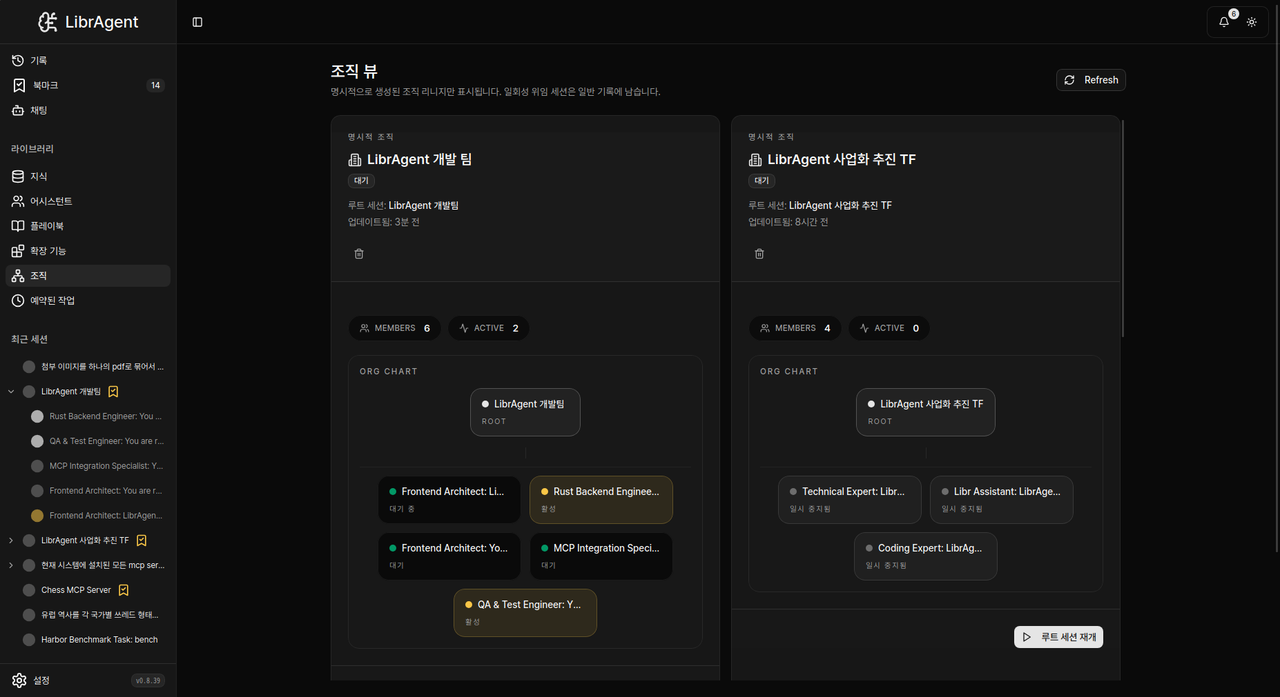
Isolation rules
Children use their own workspace by default.
- Workspace guidance (
agents.md/AGENTS.md/CLAUDE.md/GEMINI.md) and workspace skills are read on the child. - Assistant-scoped skills follow the assistant chosen for the child.
- Global skills are available to parent and child.
- To share a folder, skills/agents set
workspaceOverride(not an automatic copy). messageToSession(reset=true)clears the previous conversation, planning, pending messages, and runtime state but does not delete workspace files. It also closes the browser session, so usereset=falsewhen browser state must be preserved.
If the child “assumes” parent-only files, local skills/, or workspace rules, delegation fails. Put goal, scope, output format, required paths in the handoff, or use a shared workspace / workspaceOverride.
Tool names and troubleshooting: follow the bundled @skill:delegate body.
Which skill when?
Mention @skill:name or tell the agent the pattern name.
1) One-shot delegation · basics
| Skill | When |
|---|---|
delegate | Create / watch / nudge children and workspace isolation — baseline for other patterns |
recruit | Create a new specialist assistant config (not session delegation itself) |
boost | Trim / strengthen tools on an existing assistant |
@skill:delegate
Read only the auth module in this repo and summarize vulnerability candidates in Markdown.
2) Work-splitting patterns (ephemeral children)
| Skill | Pattern | One line |
|---|---|---|
divide-conquer | Parallel split | Non-overlapping pieces → merge |
hub-spoke | Hub–spoke | Coordinator steers workers; no worker-to-worker chat |
pipeline | Sequential | A output → B input → C … |
consensus-delegation | Multi-view | Same question to 2–4 experts → parent reconciles |
gatekeeper | Quality gate | Creator ↔ Reviewer loop (retry limit) |
pair-programming | Pair | Driver / Navigator on a shared workspace |
@skill:divide-conquer
Split frontend, backend, and docs review reports in parallel, then merge into one.
@skill:consensus-delegation
Review this PR from security, performance, and maintainability angles and reconcile opinions.3) Persistent teams · Org
Different from one-off delegation. Use when you need team artifacts and Org UX.
| Skill | Role |
|---|---|
teamwork | Scaffold task force, artifact dirs, coordination model — prepare first |
org | After agent__createOrg, member sessions appear under Org. Resume from the Org root |
org-restructure | Add/trim roles or edit charters (agents.md, …) on an existing Org |
Flow: teamwork scaffold → org create/spawn → resume from sidebar Org → change structure with org-restructure.
- Org ≠ scheduled automation (
schedule) ≠ in-session clock reminders (loop) ≠ completion-signal resume (call-me-back) - Plain parent–child delegation alone does not show under Org
@skill:teamwork
Create a research / implement / review task force and coordinate with hub-spoke.
Quick picker
| Goal | Use |
|---|---|
| One child, get the result | @skill:delegate |
| Parallel independent pieces | @skill:divide-conquer |
| Central coordinator + workers | @skill:hub-spoke |
| Ordered stages | @skill:pipeline |
| Same topic, many viewpoints | @skill:consensus-delegation |
| Write ↔ strict review loop | @skill:gatekeeper |
| Two agents pair on code | @skill:pair-programming |
| Long-lived team + Org UI | @skill:teamwork → @skill:org |
| Hire a new specialist assistant | @skill:recruit (then delegate) |
| Slim tools on an existing assistant | @skill:boost |
Skill scopes and install: Skills.
Tips
- Smallest structure first — do not build a team if one agent is enough.
- Self-contained handoffs — children should not guess parent chat.
- Async spawn by default — for parallelism, skills often use
waitForResult=false. - Verify child output — paths, scope, missing workspace rules — before the final answer.
- On delete — choose whether to include sub-agents (Sessions).